

Headless ACH Pull
Embed US bank-account linking and ACH debit payments in your own interface without routing users through the Transak widget.
Headless ACH Pull (also known as Instant Bank Transfer) is a lightweight, embeddable module that lets US users link a bank account and pay via ACH debit directly within your own application, without loading the Transak widget.
Retrieve a user’s previously connected bank accounts, enabling one step checkout without relinking a bank.
Verifies the user’s mobile number and renders the bank-linking UI via the Transak SDK for a new bank account.
Problem Statement
Currently, Transak requires loading the full widget for ACH Pull payments, which forces users to go through multiple screens before they can link a bank account and pay. This creates friction and limits partner control over the payment experience.
Here are some of the key challenges with the current approach:
Our Solution
Headless ACH Pull exposes bank-account linking and payment as a standalone, embeddable flow. Partners control where it sits, how it looks, and what happens after payment. Transak handles the bank linking and ACH debit infrastructure in the background.
Here are some of the key benefits of the Headless ACH Pull solution:
How does it work?
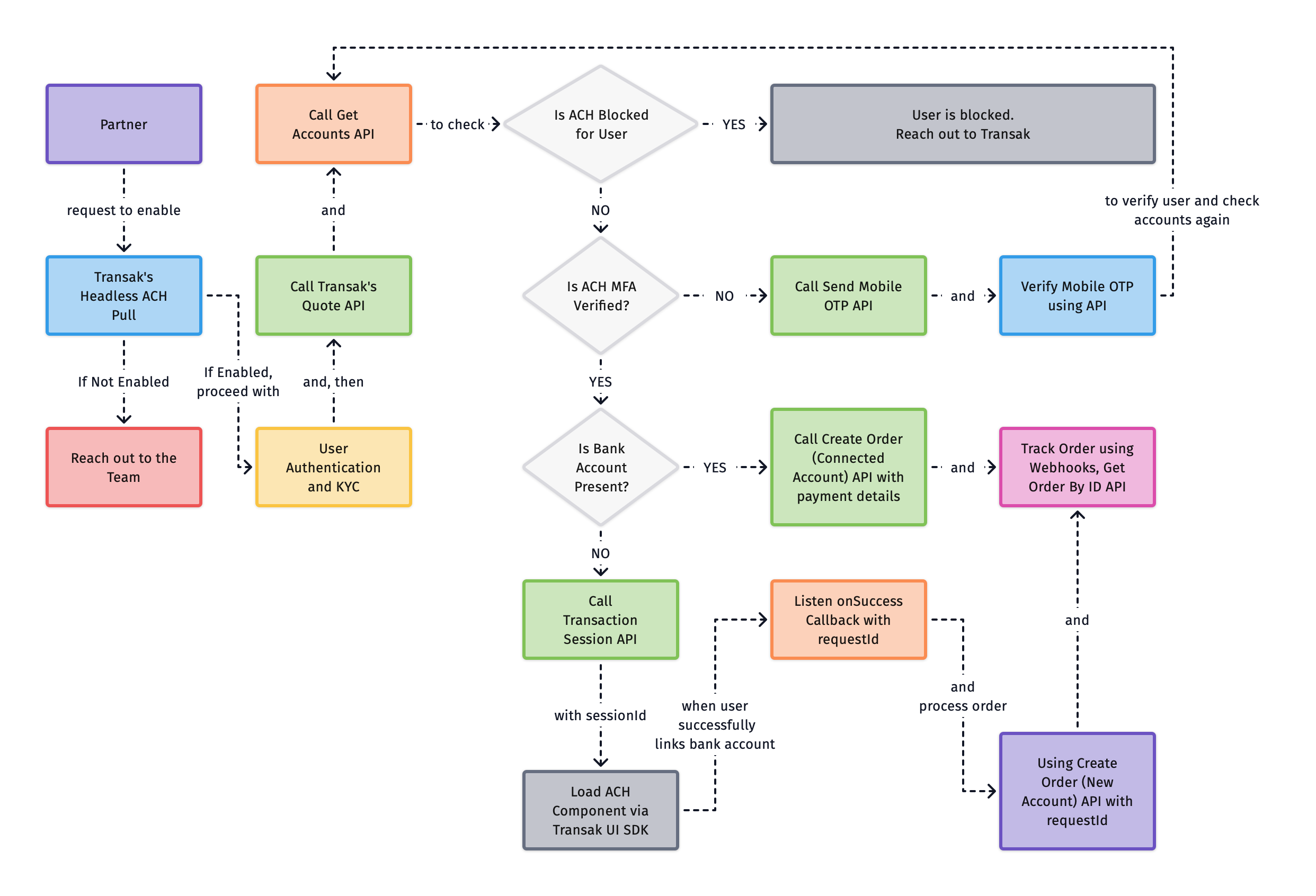
Current Limitations
How to integrate?
User Authentication
You can use either of the following authentication options:
Please refer to the tutorial on how to create partner access token.
User KYC
KYC is a mandatory step in compliance with regulatory requirements. Each user should be KYC Approved. You can use either of the following KYC options:
Generate a quote using the Quote API
Call the Get Quote API to get a quote for the transaction. Pass the apiKey, fiat amount, fiat currency, crypto currency, network, and order type.
Set paymentMethod to pm_ach_pull while creating a quote. ACH Pull only supports USD as the fiat currency.
A successful response returns a quoteId.
Check for connected bank accounts (using Backend only)
Call the Get Accounts API with paymentInstrumentId set to pm_ach_pull to check whether the user already has a connected bank account.
A successful response returns bankAccounts, isAchMFAVerified, and isAchBlocked.
Place order using the connected account (using Backend only)
If the user has a connected bank account, call the Create Order (Connected Account) API from your backend using below parameters.
A successful response returns the full order details, including orderId and status. Continue with the Track the order step below.
Send Mobile OTP (using Backend only)
If the user has no connected bank account, call the Send Mobile OTP API from your backend with the user’s US mobileNumber.
A successful response returns a mfaSessionId.
Verify Mobile OTP (using Backend only)
Call the Verify Mobile OTP API from your backend with the mfaSessionId from the previous step and the code the user received on their mobile number.
Create a transaction session (using Backend only)
Call the Transaction Session API from your backend using the quoteId and the user’s wallet address. You can optionally pass a config object to customise the color mode of the bank-linking component.
A successful response returns a sessionId.
Load the ACH Pull Component via Transak UI SDK
Use the Transak UI SDK to render the bank-linking component. Pass the sessionId received in the previous step.
The video below shows the ACH Pull bank-linking flow. This entire flow runs through the Embeddable Transak UI.
JS
React
React Native
Error codes
The onError callback receives a code value. Use it to handle specific failure scenarios:
Place order using the new account (using Backend only)
Once the SDK fires onSuccess with a requestId, call the Create Order (New Account) API from your backend using the requestId to complete the payment and create the order.
A successful response returns the full order details, including orderId and status.
Track the order (using Backend only)
The Create Order response already contains the orderId and status. Use the Get Order by ID API to poll for full order details until the status reaches a terminal state.
API Overview
Retrieves the user’s connected bank accounts and ACH Pull verification status.
Sends an OTP to the user’s mobile number to begin the bank-linking flow.
Verifies the OTP code sent to the user’s mobile number.
Creates a transaction session using a quote ID and wallet address, returns a sessionId to initialise the bank-linking component.
Places a crypto buy order using a newly linked bank account, based on the requestId returned by the SDK’s onSuccess callback.
Places a crypto buy order using a previously connected bank account.